Technology compared
Hydronic, electric cable or mat: what fits your driveway.
Every heated driveway warms the slab from below. The difference is what carries the heat. SunFlow builds hydronic systems only, and this page says why, with the trade-offs.
Side by side
| Compared on | Hydronic | Electric cable | Electric mat |
|---|---|---|---|
| How it heats | Warm water and propylene glycol pumped through PEX tubing from a boiler | Electric resistance cable under the surface | Electric cable pre-spaced on a mat |
| Upfront work | More involved: a boiler, a manifold and tubing | Often cheaper to install | The easiest to install |
| Running cost | Lower, according to SunFlow's guide. About $2 to $5 per snow event for a standard two-car executive driveway | Can be significantly more expensive to run on Ontario's grid | Ask SunFlow |
| Response in deep cold | Even heat across a large surface, with a manifold balancing the loop | Ask SunFlow | Slower to respond in deep freezes, in SunFlow's experience |
| Lifespan | Built to perform for decades when properly maintained | Ask SunFlow | Shorter, in SunFlow's experience |
| Other notes | Quieter and more adjustable. Can tie into an existing gas or green energy system | Not stated | Not stated |
| Installed by SunFlow | Yes | No | No |
Inside a hydronic driveway
Five layers, one of them warm.
Tube spacing is set from BTU calculations for your local climate. On a new build, insulation goes in under the tubing so the heat travels up to the snow and is not lost into the ground.
The parts you never see once it is finished
Tubing on mesh before the pour, the manifold that balances the loop, and the boiler that warms the fluid.
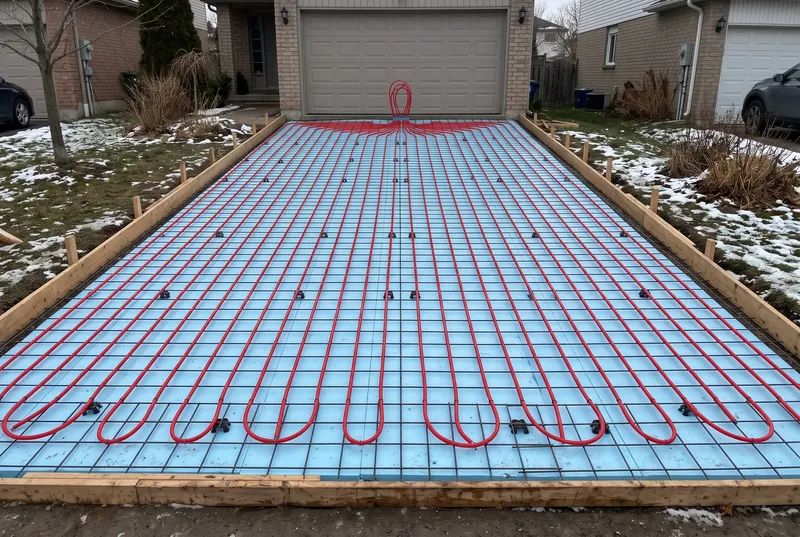
PEX tubing on reinforcing mesh before the pour
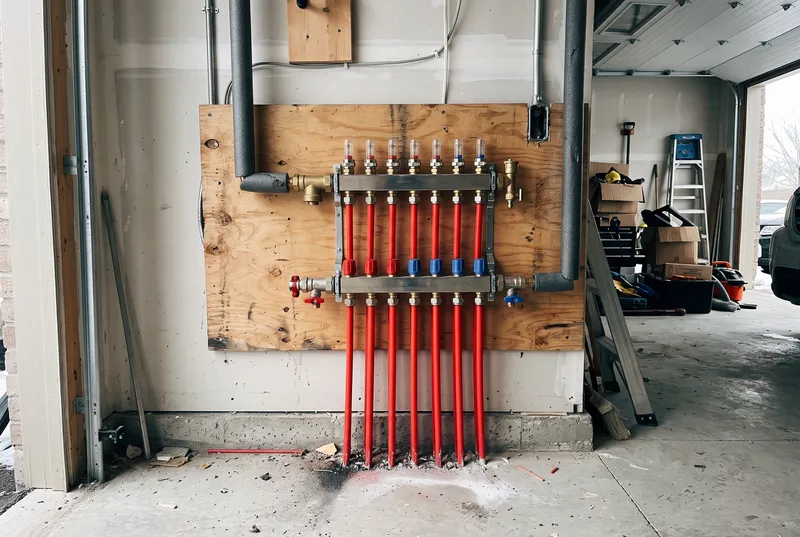
Supply and return manifold on the garage wall
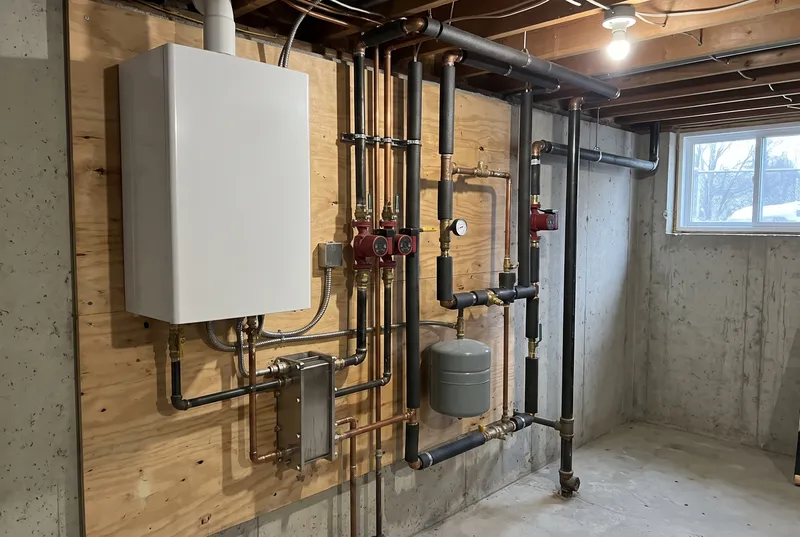
Boiler, heat exchanger and pumps for a snow-melt system
What fits which driveway
Your surface and your timing decide the method.
- New build or full replacementThe most cost-effective time to add heat. The tubing goes into the base before the surface is poured or laid, with full insulation underneath.
- Existing asphalt or concrete in good shapeGrooves are saw-cut into the surface, the tubing goes into them, and they are sealed with a weather-resistant polymer.
- Existing paversThe pavers are lifted, the tubing grid and insulation go in, and the same pavers are reset on top.
- Cracking or heaving drivewaySunFlow recommends a full replacement, so the heating system lasts.
- ConcreteHolds and radiates heat well. Needs planned expansion joints.
- AsphaltThe most cost-effective surface, and its dark colour helps it melt snow.
- PaversNeed a specific bedding process so heat reaches the surface through the sand and stone.
Planning ahead helps: SunFlow suggests starting at the design stage, or at least 3 months before you pave, to leave time for utility planning and the boiler room.
Next step
Start with a conversation about your property.
Most consultations take less than 45 minutes and come with no obligation. Bring rough driveway measurements and the surface you have in mind, and SunFlow takes it from there.